
A Journey of Reflection and Resilience: Exploring the Kumano Kodo Trail
- theweatheredsole
- Aug 5, 2023
- 4 min read
Updated: Sep 21, 2023
Takahara: Leaving the Village
Leaving Takahara Village after a delightful breakfast with the inn owner 🙇♂️ , I embarked on the next leg of my spiritual journey along the Kumano Kodo pilgrimage. The owner's warm hospitality and the bento box they provided for my trek ahead filled me with gratitude for the camaraderie shared among pilgrims. As I climbed to Judo-oji, a serene ridge, I discovered intriguing parallels between the Pegan Pentagram and the Japanese Hokyonito. Both symbols embodied the connection between earthly elements and the divine, signifying the interplay of nature and spirituality. Signs along the trail hinted at the remnants of tea houses from a bygone era, reminding me of nature's eternal embrace and its eventual reclamation of human endeavors.
Kumano Kodo Nakahechi Michi-no-Eki
Halfway through the day's hike, I found respite at the Kumano Kodo Nakahechi Michi-no-Eki, a small road station. As I enjoyed lunch 🍱 , the locals reminded me to watch out for leeches, a reminder of the region's lush and diverse ecosystem, and also reminding me of how squeamish I can be. My journey continued with the encounter of a Gyuba-doji statue, symbolizing the pace of the Kumano pilgrimage, which is slow like a cow 🐮 while ascending mountains and swift like a horse 🐴 during descents.
Chikatsuyu-oji
As I crossed over a pass, I arrived at Chikatsuyu-oji, one of the oldest Oji shrine sites on the Kumano Kodo route. Although the shrine itself was dismantled in the early 1900s, its spiritual presence lingered, adding a profound sense of sacredness to the surroundings 🌲. The echoes of past pilgrims resonated in the air, reinforcing the enduring nature of spiritual quests that transcend time.
Tsugizakura-oji
Completing my day's journey at Tsugizakura-oji, meaning "grafted cherry tree," brought me into the heart of the enchanting forest. Surrounded by majestic cedar trees, some more than 800 years old, I found myself marveling at their resilience and the cyclical nature of life. The alignment of the trees, all who's branches were pointing south 🧭 , poetically mirrored the pilgrim's path, guided by a profound sense of direction and purpose.
Kobiro-Toge
The morning brought the most challenging section of my Japan pilgrimages, with steep climbs at Kobiro-Toge. I found myself deep in the Japanese mountains passing through many landmark towns that have since been consumed by the forrest leaving only trees and some semi-stacked rock walls. If it wasn’t for the plaques explaining the history of the towns, I would have passed though unbeknownst. It was a profound realization that I was walking through town squares that for hundreds of years during their prive, were bustling with activity, life, drama, and hope... and nothing remains now but nature. It was an impactful realization that nature dominates our world and over time it rebalances and swallows just about everything we can create. Further down the trail I learned about the historical sandals 🩴 used by pilgrims added a new perspective to my own pilgrimage, appreciating the advancements in modern hiking equipment. The trail detoured from the origional path here which led to an almost rock-climbing experience, serving as a metaphor for life's unpredictable detours and the tenacity required to overcome obstacles 💪 .
Miloshi-Toge
As I reached Miloshi-Toge, the last major pass of the day. It is from the trees harvested from these very woods that used in constructing the grand shrines of Kumano ⛩️. The connection between nature and sacred sites deepened my appreciation for the profound spiritual significance of the Kumano region.
Hosshinmon-oji
Pausing at Hosshinmon-oji, one of the five major oji shrines, brought me to the outermost entrance of Kumano Hongu Taisha's sacred precincts. The downhill path unveiled awe-inspiring views, culminating in a breathtaking sight of Oyunohara and the colossal Torii gate 😮 , a majestic symbol of the shrine's grandeur, and the end of the day's trek.
Hongu Townsite
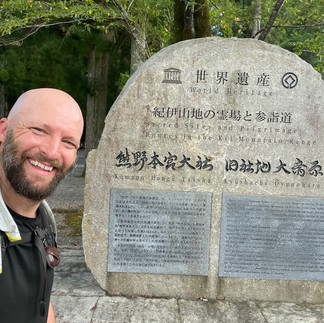
The final leg of my day's trek led to Hongu, where the massive Otorii Torii gate greeted me at the entrance. The symbolic significance of this gate as the largest in Japan filled me with reverence and wonder. Measuring about 33 meters high and 42 meters wide 📏 , it is considered the largest torii gate in Japan and serves as an iconic symbol of the shrine. Hongu is part of the “Kumano Sanzan,” a collective term for the three grand shrines of Kumano. The other two shrines are Kumano Nachi Taisha and Kumano Hayatama Taisha. The Kumano Sanzan collectively represents the ancient religious landscape of Kumano. From here I walked (but shouldn’t have 😬 ) to my inn next to the Yunomine Onsen. Drank great saki, ate wonderful food, and passed out from the long day’s trek.
Each step along the Kumano Kodo trail has served as a reminder of the cyclical nature of life, where ancient traditions intertwine with the present, and the resilience of nature harmonizes with the resilience of the human spirit. The Kumano Kodo pilgrimage continues to unravel the mysteries of the world and the self, enriching my journey with reflections on the interconnectedness of all things.
Other items of Note
Takahara -> Tsugizakura-oji
Distance Traveled: 8.87 miles (14.27 km)
Elevation Gained: 2,631 feet
Tsugizakura -> Hongu (+)
Distance Traveled: 19.06 miles (30.7 km)
Elevation Gained: 3,197 feet
Music I’m Walking To
Dab the Sky (Said the Sky & Dabin) - Digital Mirage (https://youtu.be/XX5nL9EJiWU)




Note: Proofread (although not well this time, ended up reworking it myself afterwards) and stitched by ChatGPT

